Dear @diana_harosa @Marco_EOM
Greetings from cloudy Ireland.
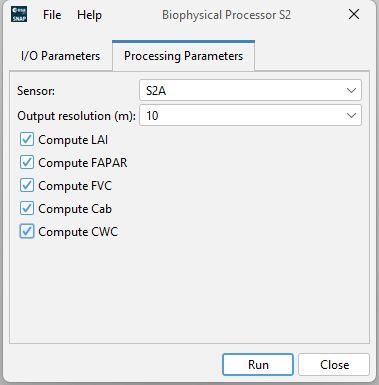
I am ever so grateful for your kindness in helping researchers to make the best use of the comprehensive SNAP software. Thanks to your support, I finally obtained an LAI for the area of interest, with try and error.
Q1) Since I am using the S2A product in cloudy Ireland, will it be beneficial to further perform cloud correction before running the Biophysical processor, such as running the image through sen2cor software?
Q2) My understanding is that it will be best to mask cloud contamination before running the Biophysical processor or is it better to run the Biophysical processor and then remove the clouds, which are flagged given a known issue with the Flag classification?
Q3) If we mask the cloud beforehand, then it is not clear which is the best algorithm to use, as it is not clear for the 10 m resolution derived LAI product, what is the maximum cloudness the S2ToolBox can handle, any recommendation will be welcomed?
Now the next challenge is to automatise the process.
BUGS
Kindly let me know if I should fill out a bug report:
1: In the Biophysical processor, writing to .GeoTIFF fails when opening in QGIS, and therefore, one should use instead GeoTIFF-Big.TIFF
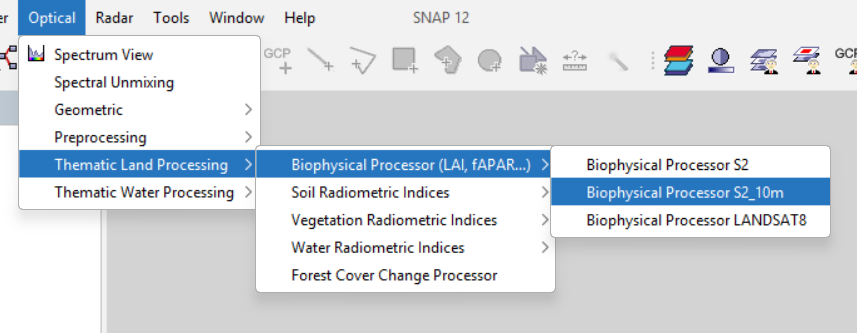
2: if one resampled to 10m before using Biophysical Processor, then one should use Biophysical Processor S2_10 and not S2, as the algorithm resamples again and reduces the image’s sharpness.
3: To save to GeoTIFF, one can only save one variable at a time such as LAI.
Many thanks for all your support,
Joseph A.P. Pollacco
 Marco from