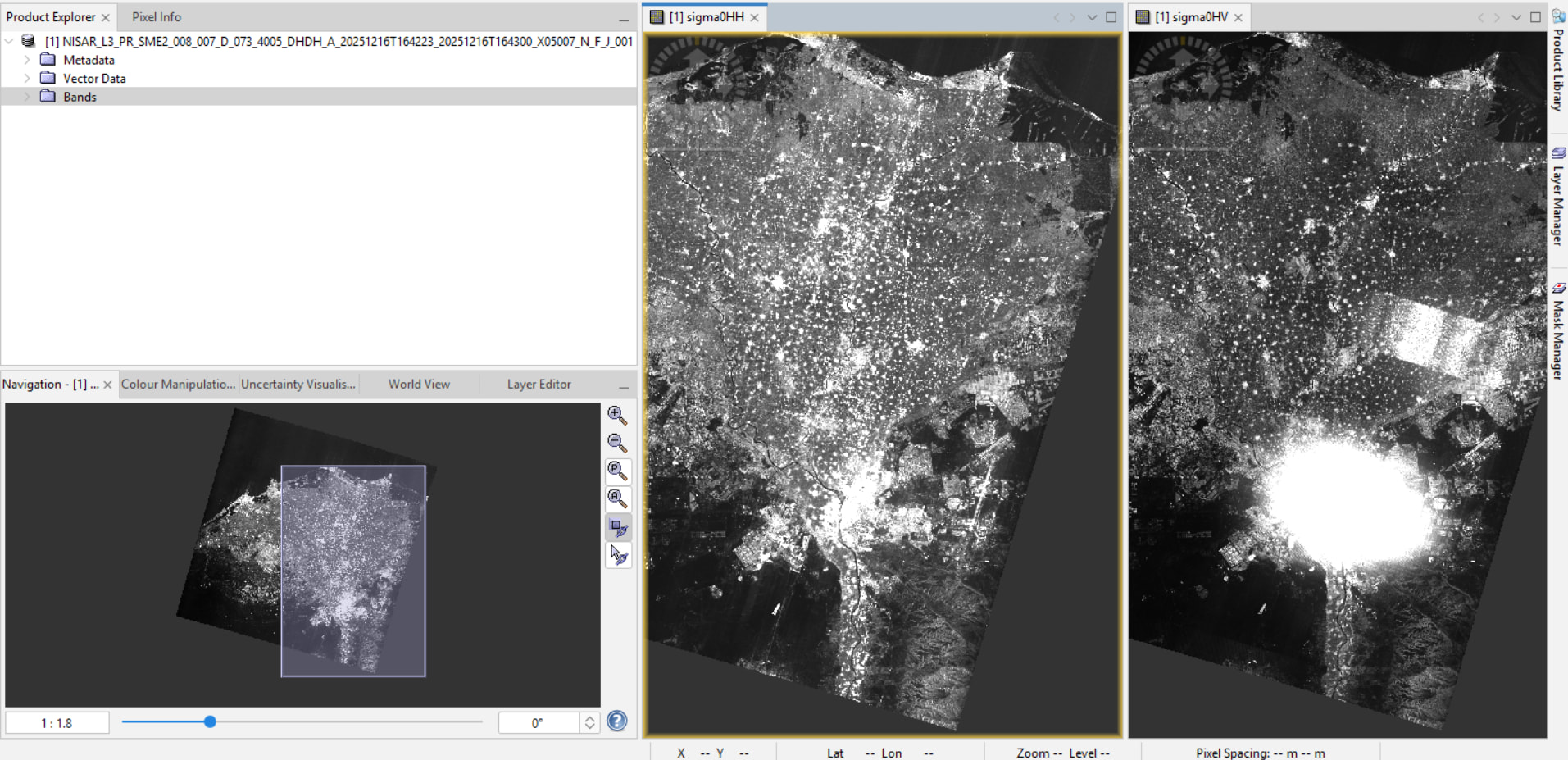
I’d want to be one of the early birds raise an inquiry regarding the new relies samples of NISAR, if any has any clarifications.
Based on the previous experience with S1, and other open SAR data, I do believe this is the results of Ground radio frequency interference (RFI). More details also possible be found in the following topic.
The question is, Both HH, HV, polarizations are acquired simultaneously at the same sending and receiving time of pulses, And there are radar signal on the ground, Now , Why HV -pol is affected and not HH - pol. ?
BTW the image is L3 L band,
In HH-HV the first letter refers to the polarization of the emitted signal (by the sar sensors) the second letter is the polarization of the signal it receives back.
If the RFI occurs only on the v pol receive it means that relative to the receiving antenna the interfering wave has a strong vertical pol component.
Cross pol channels like HV typically tend to be 2-3dB darker than co-pol channels like HH (even in S1). So artifacts like ambiguities, RFI etc stand out more easily in cross pol channels.
1 Like
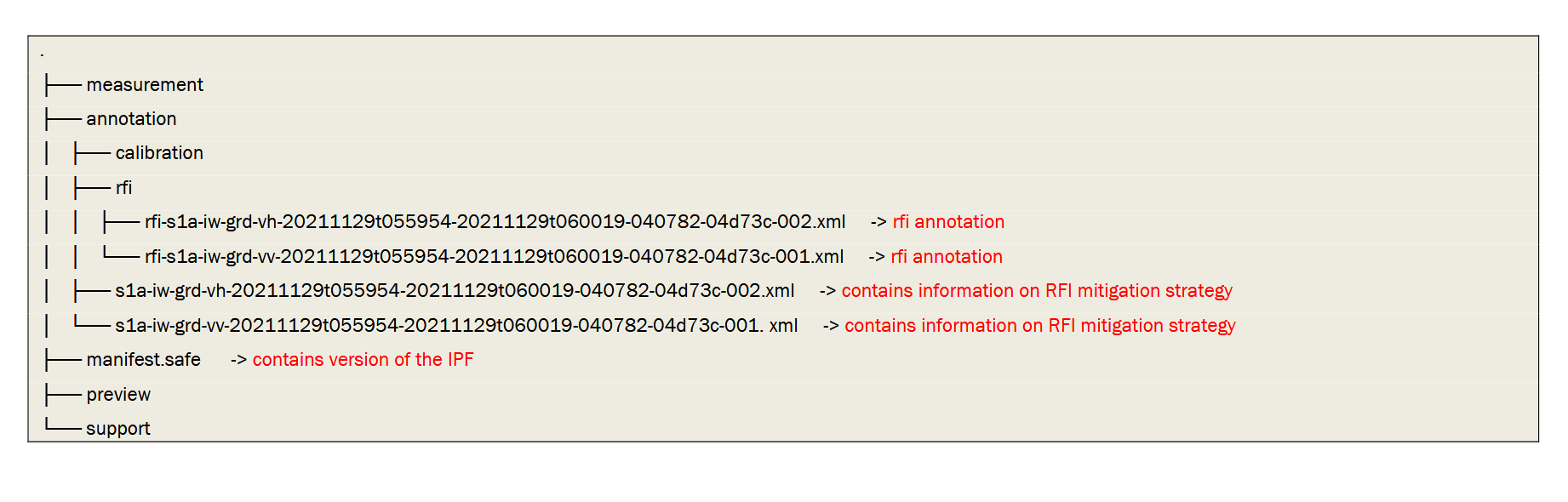
Thanks both for your answers, But I still looking for more detailed related to physics answer, What you mentioned both is correct, But still there is an another fact behinds this, most of the ground nowadays are full of ground artificial radar waves for multiple reasons, (RFI mitigation and impact on product performanc), Here is an example for S1
Also put in mind that this is L3 is calibrated to sigma0 Linear not dB, and not L1, Still there’s a lack of applying
Here is one more example Joint Investigations on Radarsat-
2/Sentinel-1A Mutual RF
RFI Artefacts Detection in Sentinel-1 Level-1 SLC Data Based On Image Processing Techniques
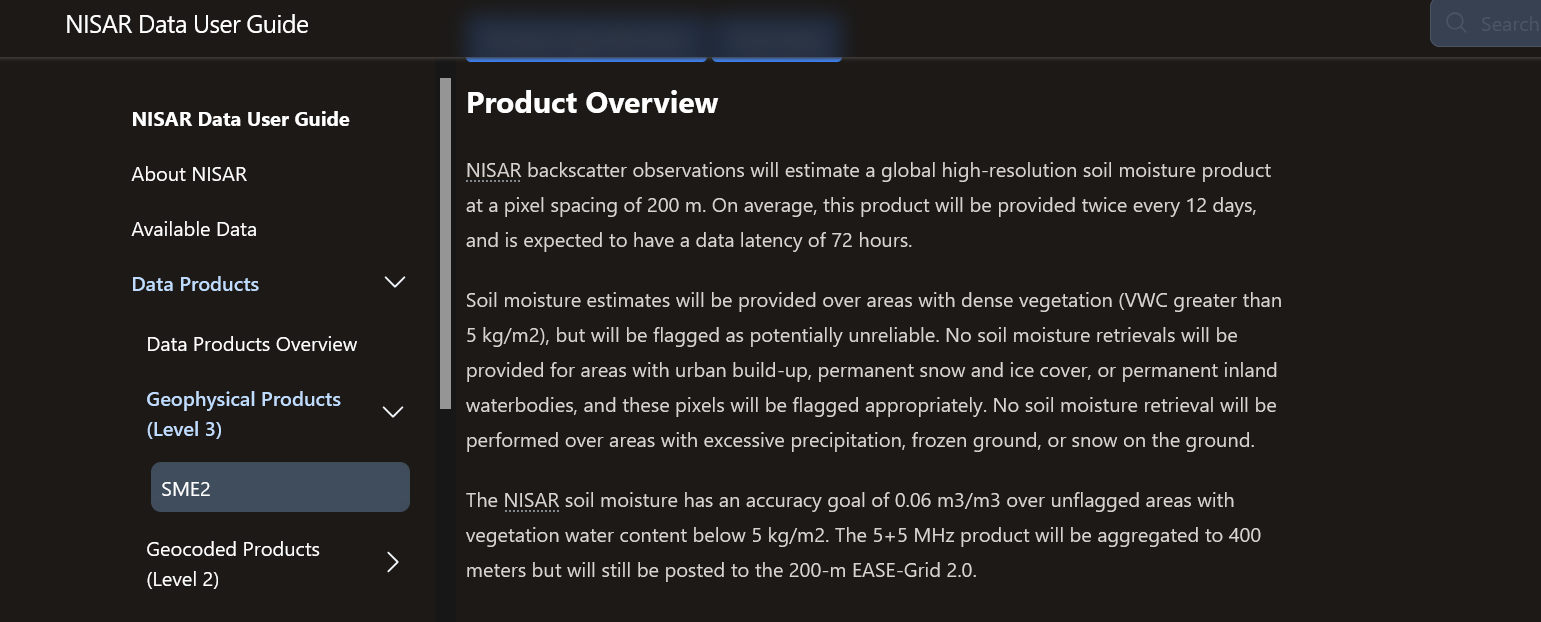
Do note that these are preliminary versions and NISAR data is still being calibrated. You want the mission calibration process to be completed before expecting all those pieces of information to show up. As you point out this is L3, and RFI mitigation belongs at lower levels and we do see relevant fields for it in the GCOV product

Thanks a lot for your time spending responding to my inquiries, but in the same time this could be returned knowledge to other colleagues as well, But my main point in here probably I didn’t very successful represent it, which is I feel something is missing in signal processing, related to the ground station, antenna, or something else, because the early release should be subjected to calibration, and validation, please correct my point if it doesn’t make any sense.
Many of us would respectfully disagree with your previous statement. The release clearly outlines a timeline and sets expectations for fully calibrated data. Some of the major limitations are also clearly laid out. These sample datasets are great to start preparing for the large volume of data that is expected to flow.
Thanks a lot , let’s wait until the release of S-band for the same or other area to find out more, also it’s important to discover more via SNAP-14 release as I found with the Step Forum, that the new upcoming version will carry more for NISAR processing, then we could find more.
My doubts are , that this is the first two radar bands in the same satellite based on my information, and I’m afraid of intersections of return pulses.
S-band (~2–4 GHz) and L-band (~1–2 GHz) do not overlap in frequency, so they won’t intersect spectrally. However, at the antenna/receiver, we can see interaction