Dear All,
We need to calculate the NRCS values of the particular scene from the SAR image. Specifically we need to differentiate NRCS values of VV-polarization and VH-polarization. In order to accomplish this work, we refer the document “Radiometric Calibration of S-1 Level-1 Products Generated by the S-1 IPF”. While doing this work, I had the following doubts.
Digital number:
    1. Digital number represents which value?
    2. This value is difference from the actual pixel value. That is if we download the image and read it in MATLAB it shows different values.
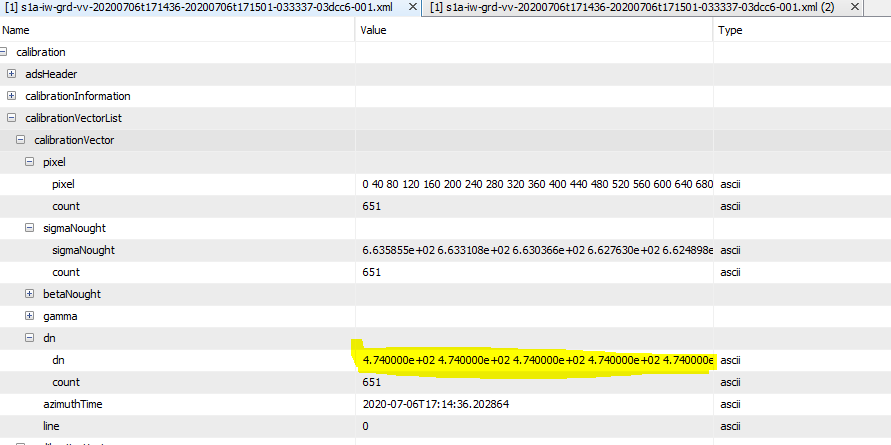
    3. Further, Why this DN value is same for all pixels? This is representation is illustrated in the following image.
SigmaNought:
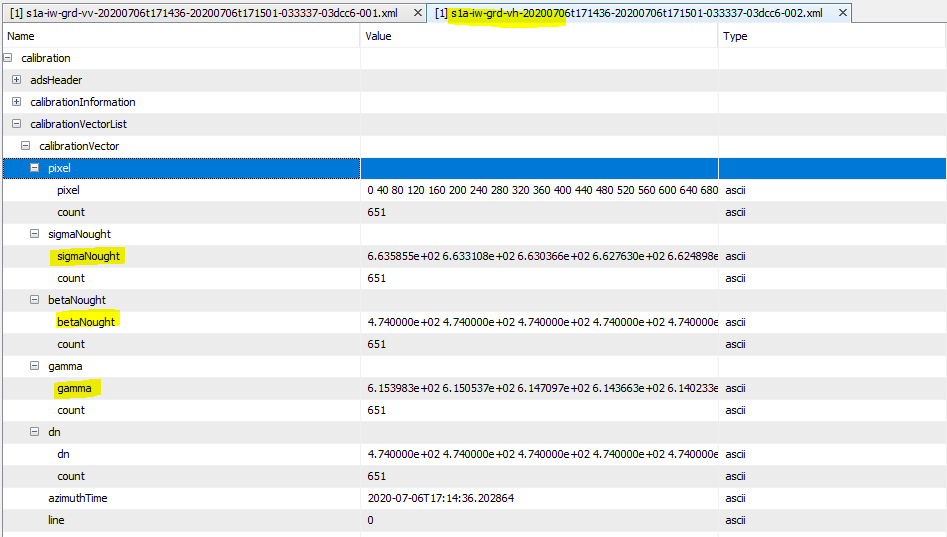
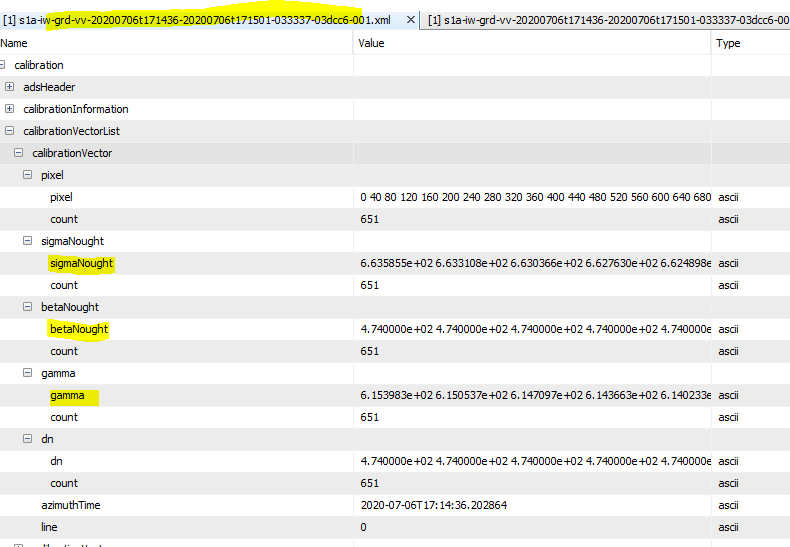
     1. Why sigmanought, betanought and gamma values are same for VV and VH polarization?  If these values are same in both polarization, then there is no meaning right? This issue is given in the following figure.
     2. Further, Is beta value same as DN?
Pixel:
1. Is pixel in the calibration vector denote exact pixel value or else from - to values? (ie) if pixel 40 means - 0 to 39. If it is not what will be the values for intermediate pixels?
Line:
1. Same doubt as in pixel. Is line in the calibration vector denote exact pixel value or else from - to values? (ie) if line 668 means - 0 to 667. If it is not what will be the values for intermediate lines?
NRCS calculation:
         1. If I have to calculate the NRCS value of the particular region, for example,  I need to calculate the NRCS value of the pixel number 8720 and the line number 5300, then no.of.pixels in that region is 5300 x 8720 right? If I am wrong kindly provide the way.


 I have these doubts. Kindly clear my doubts. Thanks in advance.
Thanks and Regards,
M.Shanmuga sundari.
1 Like
Perhaps @ghajduch could point you towards the right direction.
Dear Mengdahl,
Thank you for your suggestion. How do I contact @ghajduch?
Thanks and Regards,
M.Shanmuga sundari.
Sorry for late answer, I was not having a look to the this forum during a while.
This detail of radiometric calibration procedure is not provided in the document “Radiometric Calibration of S-1 Level-1 Products Generated by the S-1 IPF”
The calibration vector lists are provided for specific azimuth times provided in the calibrationVectorList/calibrationVector/AzimuthTime elements.
For each calibration vector the LUT information is provided for specific pixels annotated in the calibrationVectorList/calibrationVector/AzimuthTime element. The value of pixel has to be considered as location of center of pixel. The first annotated position of pixel should be 0 while the last annotated position of pixel should be the number of pixels in the dataset.
The LUT is not provided explicitly for all row and all pixel. The way to get the LUT values between the provided rows and pixels is not provided explicitly in this document. We recommend to interpolate it.
The document is proposing to compute the mean NRCS of a distributed area by computed first the mean of quadratic values of Digital Numbers and then to apply the LUT. However this approach can only be considered valid for small areas, smaller than the spacing of annotation in row and pixel. For large areas we recommend to convert the values to sigma0 (respectively beta0 or gamma) applying the LUT to each pixel and only after this to average the values.
Performing the averaging at the very end of the process is recommended, especially if you consider to apply a denoising as described in https://sentiwiki.copernicus.eu/__attachments/1673968/DI-MPC-TN-MPC-0392%20-%20Thermal%20Denoising%20of%20Products%20Generated%20by%20Sentinel-1%20IPF%202024%20-%202.3.pdf
1 Like
This point was added in the FAQ of the SAR-MPC here:
1 Like