I noticed that in a Sentinel-1D image (2026-05-30), some corner reflectors I am monitoring were no longer visible. The strange thing is that the same CRs were clearly visible in the previous Sentinel-1C acquisition (2026-05-29) and in the following Sentinel-1A acquisition (2026-06-04), as well as in the rest of the time series, including previous Sentinel-1D acquisitions. I cannot check the next Sentinel-1D image because it has not been acquired yet. Of course, all images have the same acquisition geometry (i.e., same relative orbit number), and I’m looking at VV backscater coefficient only.
Nothing happened to the corner reflectors based on field inspections, and there were no changes in temperature, weather, or terrain between May 29 and May 30 at 05:30 AM (acquisition time of the S1C and S1D passes).
To investigate further, I created a color composite between the two acquisitions (S1C pre-event and S1D post-event), assigning S1C to the red and blue channels and S1D to the green channel. Given the short time interval (1 day) and the similar weather and surface conditions, the result should appear mostly gray, indicating minimal backscatter change. Instead, the image shows strong green and purple patterns, indicating significant increases and decreases in backscatter. The variations appear systematic and substantial, on the order of ~10 dB, which is unusually large even for rapidly changing snow or terrain conditions, especially over such a short time period and at the same acquisition time. (I work on SAR remote sensing of snow and avalanches)
In the image, you can clearly see a strong backscatter decrease at the corner reflector locations (purple dots), as well as along the main ridge of the mountain.
At the moment, I cannot explain this behavior, but I believe it is important to understand it further. Does anyone noticed something similar or knows something about this? Am I missing something?
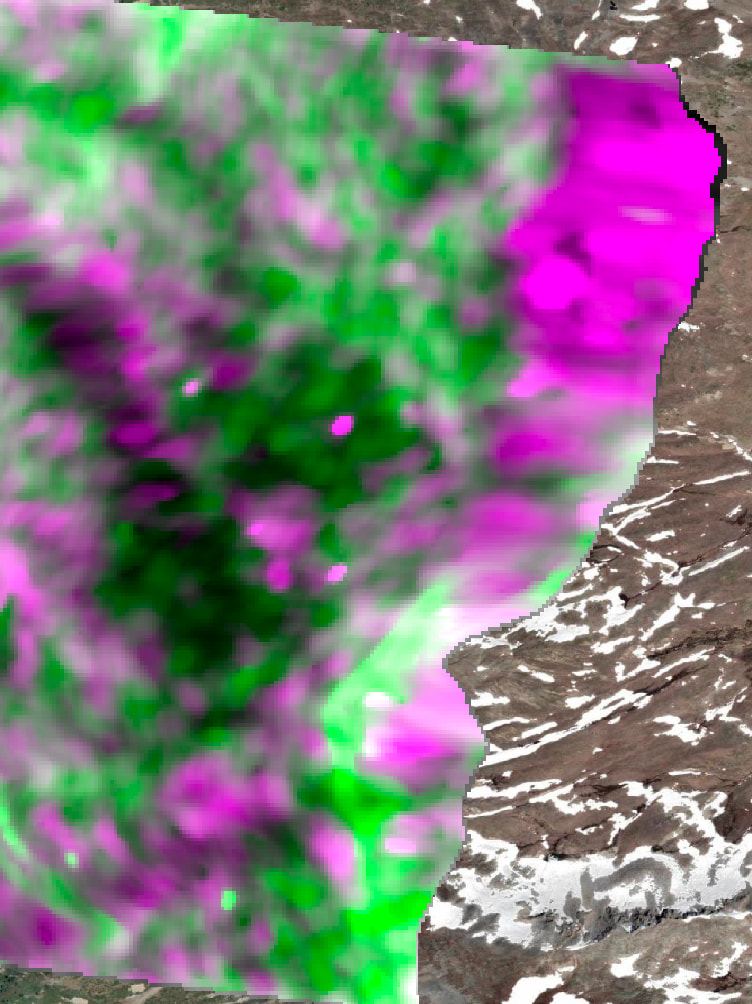
Here the parameters to reproduce what I’m observing:
AOI: {“type”:“Polygon”,“coordinates”:[[[10.144501,46.49981],[10.144501,46.549889],[10.180206,46.549889],[10.180206,46.49981],[10.144501,46.49981]]]}
The relative orbit number is 168.
Dates ranges: 20260528 - 20260605 (S1C - S1D - S1A)