I couldn’t find any technical description of what does unsupervised classification algorithm do with multiple source bands. I found that the classification results made by multiple source bands are indeed better than ones made with a single band, but I couldn’t find a clear justification of which bands to be chosen as sources.
(I’m working with Dual polarization images so I tried to combine the two polarizations in several ways e.g. average, ratio )
If you work with unsupervised classifiers, I’d say the more input layers the better.
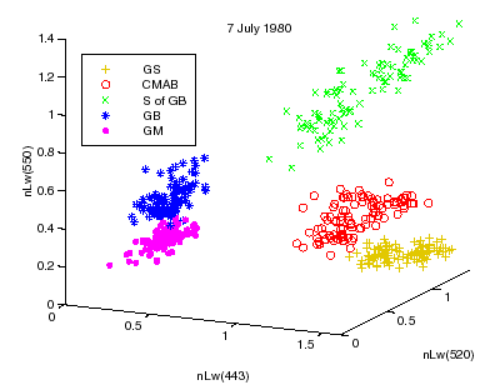
Think of the n-dimensional feature space concept:
The clustering below is based on three axes (three input rasters). If it was only two dimensions blue/purple or red/yellow wouldn’t form such distinct clusters.
Source: http://www.whoi.edu/science/B/people/lmartin/OOXIVposter/postersumm.html
If some bands are not ‘useful’ for the classification (e.g. they show redundant information with another layer) their inpact on the result won’t be high.
I found nice slides about the topic:
www.utsa.edu/LRSG/Teaching/EES5083/L8-classif.ppt